Best Sand ATV Trails in Texas: Coastal Dunes and Desert Rides (2026)

Alana Azzouz is a Senior Editor at Searchshop Media Network with over a decade of experience in consumer content quality and editorial standards. She has reviewed thousands of product guides, buying articles, and comp…
Why trust us
BestATVTrails trail guides are researched by riders with decades of powersports experience. Our lead researcher spent 30+ years in powersports retail and has ridden trails across a dozen US states. Every gear recommendation is sourced from real product research matched to specific terrain — not paid placements or generic affiliate lists.

Best Sand ATV Trails in Texas: Coastal Dunes and Desert Rides
Gear for This Trail

Loose sand, salt air, heat, and long open sections call for gear that protects against roost, improves visibility, and helps your machine stay mobile if you bury it. We recommend the following setup for Texas sand riding.
| Gear Type | Brand | Product | Why It Suits This Trail | Approx. Price |
|---|---|---|---|---|
| Helmet | Bell | Qualifier Full-Face Helmet | A full-face helmet works well for coastal wind, blowing sand, and faster open sections. The Bell Qualifier is widely available, reasonably priced, and gives better face protection than an open helmet when sand gets kicked up. | $120-$180 |
| Gloves | Fox Racing | Dirtpaw Gloves | Sand riding requires constant bar input, and these gloves offer solid grip, knuckle coverage, and good value. They also work well in humid coastal conditions without feeling overly bulky. | $25-$35 |
| Chest/Upper Body Protection | Alpinestars | Bionic Action Chest Protector | Great for dune-style riding and mixed park terrain where roost, handlebar impacts, or a quick over-the-bars incident are possible. It adds coverage without being as heavy as full armor. | $130-$180 |
| Terrain-Specific Item | CST | Sandblast Paddle Tire | If you're riding softer zones at Red Sands or deep coastal play areas, a paddle-style rear tire can make a major difference in flotation and forward drive. It is one of the most terrain-specific upgrades for serious sand use. | $90-$160 per tire |
| Recovery Item | Rhino USA | Tow Strap Recovery Kit | Coastal and dune riders get stuck. A compact recovery strap is one of the easiest ways to get moving again when a machine buries to the frame in soft sand. | $30-$50 |
| Comfort/Utility Item | CamelBak | M.U.L.E. Hydration Pack | Texas sand riding often means heat, humidity, or dry desert exposure with long stretches away from services. A hydration pack is one of the smartest comfort items you can bring. | $100-$140 |
A few setup notes matter here. If you're staying on firm beach sand, you may not need a dedicated paddle tire. But for repeated trips into deep loose terrain, it can be a worthwhile upgrade. We also strongly recommend rinsing all gear and machines after coastal rides because salt and sand together are hard on everything.
Introduction
If you're searching for the best sand ATV trails Texas riders actually return to year after year, Texas offers a very different off-road experience than its rockier Hill Country and forest trail systems. Here, the draw is loose sand, open sightlines, coastal wind, and the kind of terrain that rewards momentum, throttle control, and the right tire setup. From the Gulf shoreline at Crystal Beach and Surfside to the larger riding area around River Run ATV Park and the dramatic dunes at Red Sands near El Paso, Texas gives ATV riders several ways to enjoy deep, shifting terrain.
Riders visit these areas for a few simple reasons: long stretches of open riding, beach access in select zones, a fun challenge for machines set up for soft ground, and the novelty of combining off-roading with ocean or desert scenery. Sand riding also feels different from woods riding. It is faster in places, more physical in others, and often more weather-dependent. We researched the most talked-about sand-focused riding options in Texas and built this guide to help you pick the right destination, understand access rules, and bring gear that actually matches hot, humid, loose-terrain conditions.
Trail Overview

Because Texas sand riding is spread across several distinct areas rather than one single OHV complex, the most useful way to plan is by destination. Below are the key stats for the state's best-known sand-oriented ATV riding spots.
1. River Run ATV Park – Jacksonville, Texas
- Total miles: Roughly 2,000 acres with a large network of marked and unmarked trails, mud sections, open sand, and river-bottom riding
- Difficulty range: Green to Black
- Elevation: Low, mostly flat to gently rolling East Texas terrain
- Permit requirements: Park entry fee required; no state OHV sticker typically needed for private park access
- Best season: Late fall through early spring; summer is hot and humid
- Nearest town: Jacksonville, TX
2. Crystal Beach / Bolivar Peninsula – Galveston County, Texas
- Total miles: Many miles of drivable beachfront, depending on local access and tide conditions
- Difficulty range: Green to Blue
- Elevation: Sea level
- Permit requirements: Beach access rules vary by vehicle type and local enforcement; check Galveston County and Bolivar Peninsula regulations before riding
- Best season: Fall, winter, and spring; summer can be extremely hot, busy, and soft
- Nearest town: Crystal Beach, TX
3. Surfside Beach – Brazoria County, Texas
- Total miles: Several miles of beach driving access when conditions and local rules allow
- Difficulty range: Green to Blue
- Elevation: Sea level
- Permit requirements: Local beach pass or access fee may apply depending on area and season; verify current ATV legality before planning a trip
- Best season: Cooler months and weekdays for lighter traffic
- Nearest town: Surfside Beach, TX
4. Red Sands / Hueco area – Near El Paso, Texas
- Total miles: Broad open-riding area rather than a tightly mapped trail system; mileage varies by route
- Difficulty range: Blue to Black
- Elevation: Around 4,000 feet in the greater El Paso region
- Permit requirements: Access rules can change by land management area; confirm legal riding zones before arrival
- Best season: Fall through spring; summer heat can be severe
- Nearest town: El Paso, TX
Trail Conditions & Terrain
Texas sand riding changes dramatically depending on whether you're near the Gulf Coast or out west.
Coastal sand riding: beaches, tidal flats, and soft churned sections
On the coast, the terrain is usually a mix of packed wet sand near the waterline, looser dry sand farther inland, and churned-up access points where trucks, SxSs, and ATVs have dug ruts. The packed sections can feel easy and fast, especially at low tide, but conditions can change in a few hundred yards. One stretch may be smooth enough for beginners, while the next is deeply rutted and soft enough to bog a heavier ATV.
Expect:
- Soft sand pockets that punish low momentum
- Washboard sections from repeated traffic
- Salt exposure on machines and electrical components
- Occasional standing water, tidal wash, and storm-cut drop-offs
- Hidden debris near populated beach zones
- Wind that can reduce visibility during dry spells
Near the coast, heat and humidity are major factors. Even in shoulder seasons, riders can overheat quickly because the effort required in loose sand is higher than it looks. Machines also run hotter when constantly working to stay on top of soft terrain.
River-bottom and mixed sand systems
At places like River Run ATV Park, sand is only part of the experience, but it's an important one. Riders will find river-bottom sand, loose climbs, open play areas, and sections where sand blends with hardpack, roots, and mud. This type of terrain is more technical than beach cruising because traction changes constantly.
Expect:
- Sandy corners with bermed edges
- Mixed mud-and-sand holes after rain
- Short but steep climbs and drop-ins
- Tree-lined trail sections with reduced room to correct mistakes
- Ruts that can grab front tires if you enter too slowly or too sharply
West Texas desert sand
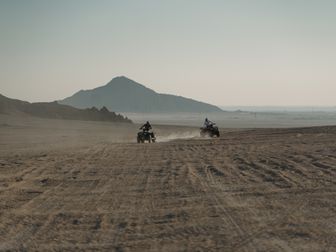
Near El Paso, Red Sands offers a more open and dune-like feel. The terrain is drier, visibility is better, and the riding is often more about rolling whoops, open bowls, soft berms, and unconsolidated sand hills than beach access. This is where paddle tires or at least aggressive sand-capable rear tires become especially helpful.
Expect:
- Deep loose sand in climbs and bowls
- Wind-shaped ridges and constantly changing lines
- More sustained high-speed stretches
- Fewer shade breaks and very dry heat
- Dust layered over sand in some sections, reducing traction predictability
Across all of these areas, the biggest obstacle is not a rock ledge or creek crossing—it's the sand itself. It steals momentum, increases steering effort, and exposes weak tire choices fast.
Difficulty & Who It's For
We use the standard Green / Blue / Black / Double-Black framework, but sand riding deserves context because even a "beginner" beach route can become much harder when the tide is high or the sand is badly churned.
Green
Best for: New ATV riders with basic throttle and braking control
Green-level sand riding is usually found on firmer beach sections or wide, flat park roads with only shallow loose patches. Riders can practice standing posture, smooth steering, and maintaining momentum without dealing with technical climbs or deep ruts.
Blue
Best for: Intermediate riders comfortable with body positioning and traction changes
Most Texas sand riding falls into Blue when conditions are average. This includes beach sections with soft entrances, open dune play areas, and mixed sand trails at parks like River Run. Riders should know how to keep weight back slightly in soft sand, avoid abrupt braking, and recover from front-end push.
Black
Best for: Experienced riders with good line choice and momentum management
Black-level conditions show up when sand is deeply chopped, hill faces are steep, or trails combine sand with ruts, off-camber turns, and traffic. Red Sands can easily ride at this level in windy or heavily used conditions, and River Run can also push into Black after weather changes.
Double-Black
Best for: Advanced riders on properly set-up machines
Texas does not have the same huge dune culture as places like Glamis, but isolated sections can still feel Double-Black when you combine deep sugar sand, blind crests, aggressive traffic, and no room for mistakes. This is less about formal trail ratings and more about real-world conditions. If you're new to sand, we recommend starting on hard-packed beach sections or easier park loops before moving into larger dune-style terrain.
Permits & Access
Access is one of the trickiest parts of sand riding in Texas because rules vary more than they do at dedicated OHV parks.
River Run ATV Park
River Run is private property, so access is generally handled through park admission fees rather than public-land permit systems. Parking is on-site, and the park typically accommodates trucks and trailers. No reservation is usually required for standard day riding, but event weekends can be crowded, so checking ahead is smart.
Beach riding access
At Crystal Beach, Surfside, and similar coastal areas, parking and access depend on the exact beach segment, local ordinances, and current enforcement. Some Texas beaches allow street-legal or beach-legal vehicle access more readily than ATV-specific use, while others may restrict ATV operation entirely or limit it to certain zones. Before you go, verify:
- Whether ATVs are legal on that beach section
- Whether a beach parking pass is required
- Whether seasonal restrictions are in effect
- Whether there are time-of-day or event-related closures
OHV sticker requirements
Texas uses the Texas OHV decal for public lands where OHV operation is allowed. However, many sand-riding destinations in this guide are either private parks or local beach access areas, where the decal may not be the main requirement. If your route includes public OHV land or managed trail systems, check Texas Parks and Wildlife rules before arrival.
Reservations and staging
Most sand destinations in Texas do not operate like tightly controlled reservation-only parks, but that does not mean you can show up blindly. We recommend confirming:
- Current access status after storms or high tides
- Trailer parking availability
- Holiday crowd levels
- Any temporary closures tied to erosion, nesting areas, or local events
Tips for Riding This System
- Air down only if your wheel and tire setup supports it. Lower pressure can improve flotation in sand, but going too low on the wrong setup risks debeading a tire. Follow your tire maker's guidance.
- Keep momentum steady instead of stabbing the throttle. In soft sand, abrupt throttle often digs the rear tires deeper. Smooth power usually works better.
- Ride the firmer line when possible. On beaches, the area closer to the waterline is often more packed, but stay alert for washouts, soft edges, and local restrictions.
- Watch tides and weather before coastal trips. A route that looks wide open in the morning can narrow fast with incoming water or become rough after storms.
- Rinse your ATV immediately after beach riding. Salt and sand are brutal on chains, bearings, fasteners, brakes, and electrical connectors.
- Carry more water than you think you need. Coastal humidity and desert heat both drain riders quickly, especially in deep sand where physical effort is higher.
- Avoid riding alone in deep dune-style areas. A simple bog can turn into a long recovery if you do not have another machine to pull you out.
FAQ
Are paddle tires necessary for sand ATV trails in Texas?
Not always. For firm beach sections and mixed-surface parks like River Run, standard all-terrain tires can work fine. For deep loose sand at Red Sands or heavily churned play areas, paddle tires or sand-focused rears are very helpful.
Do I need a Texas OHV sticker for beach riding?
Usually, beach access rules are governed more by local regulations than by the state OHV decal alone. Some beach areas may not allow ATV use at all. We recommend checking the exact county or beach authority before loading up.
What is the best time of year to ride sand in Texas?
Late fall through early spring is usually best. Coastal areas are more comfortable outside peak summer humidity, and West Texas is also much safer and more pleasant in cooler months.
Is River Run ATV Park a true sand trail destination?
It is better described as a mixed-terrain park with significant sandy sections rather than a pure dune system. That said, it is still one of the better options in East Texas for riders who want loose terrain without heading all the way to the coast or far West Texas.
Texas may not be the first state riders associate with dune culture, but it absolutely deserves a place on the map for sand-focused ATV trips. Between Gulf Coast beach riding, sandy river-bottom systems, and the open desert feel near El Paso, there is enough variety here for beginners, weekend explorers, and experienced riders looking to dial in soft-terrain technique. At BestATVTrails, we recommend planning around access rules, weather, and machine setup just as much as mileage. On sand, those details make the ride.
Get our best guides in your inbox
Top Picks & Comparison
| # | Product | Price | Rating | ||
|---|---|---|---|---|---|
| #1 |  |
Sedona CY20119L Cyclone Sand Paddle Rear Tire - Left - 20x11-9 |
$114.64 | (44) | Check Price on Amazon → |
| #2 |  |
20 x 11-10 Ocelot Sand Snake 8 Paddle Rear Tire |
$60.97 | (9) | Check Price on Amazon → |
| #3 |  |
Tusk Sand Lite Front & Rear UTV Tire Set – 32x10-15 Ribbed Front & 32x12-15 15-Paddle Rear – Off-Road Sand Tires |
$647.94 | (3) | Check Price on Amazon → |
| #4 | ![Pair of Pro Armor Sand Paddle Rear (4ply) ATV Tires [32x15-15] (2)](https://m.media-amazon.com/images/I/41MKCBo7KjL.jpg) |
Pair of Pro Armor Sand Paddle Rear (4ply) ATV Tires [32x15-15] (2) |
$395.90 | (10) | Check Price on Amazon → |
| #5 | ![EFX Sand Slinger Paddle Rear (4ply) ATV Tire [29x14-14]](https://m.media-amazon.com/images/I/514UqcS6pML.jpg) |
EFX Sand Slinger Paddle Rear (4ply) ATV Tire [29x14-14] |
$255.60 | (1) | Check Price on Amazon → |
| #6 |  |
Ocelot Sand Snake ATV Tire – 18x9.5-8 Lightweight 2-Ply Paddle Tire with 5 Paddle Straight-Blade Design, Enhanced Puncture Resistance, and Cooler Running for Maximum Sand Traction |
$47.97 | (6) | Check Price on Amazon → |